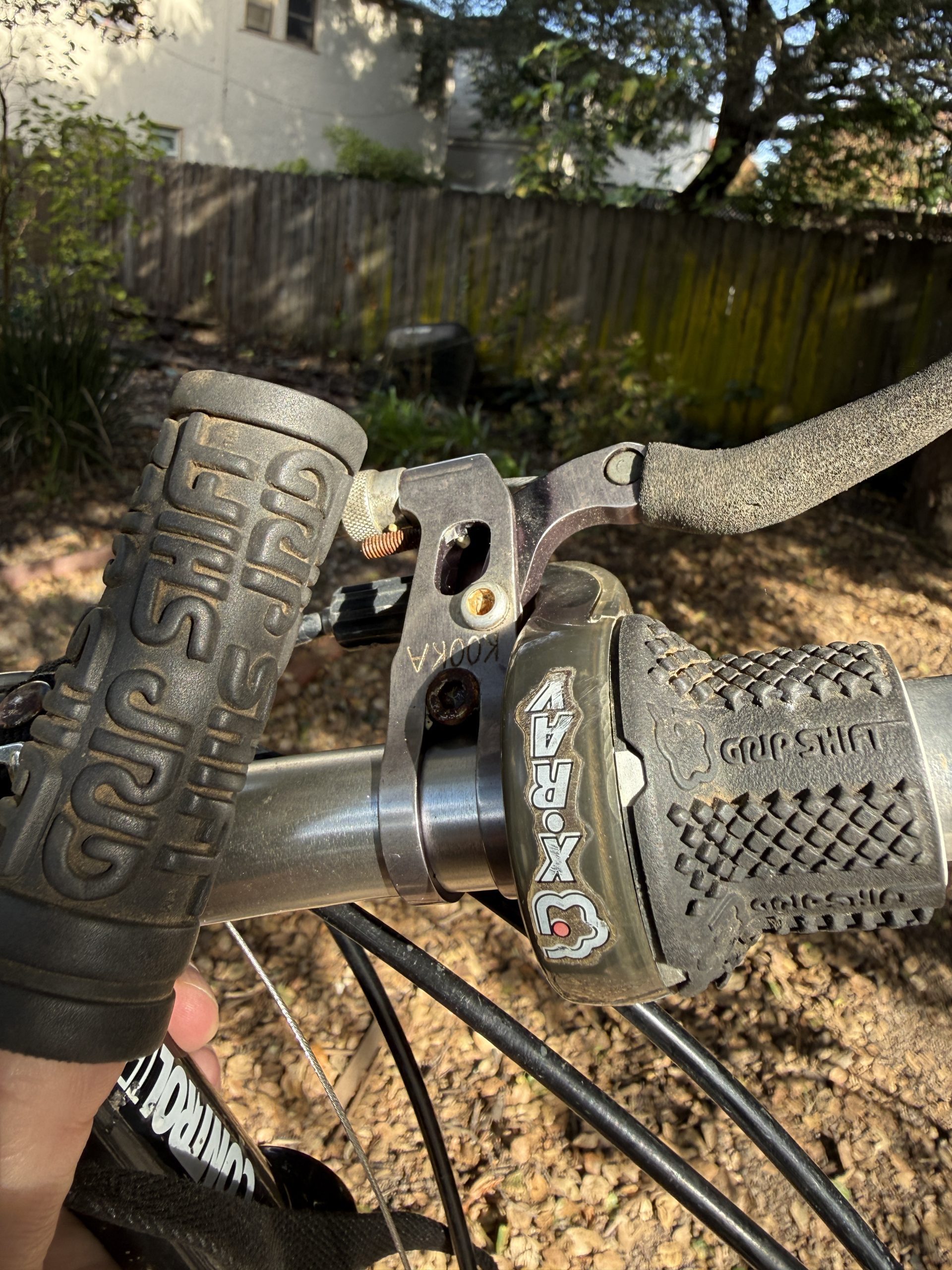
UPDATE (full story below): this is a Gripshift Bassworm invented to add more “spring” to Gripshift shifters to work with updated Shimano derailleurs.
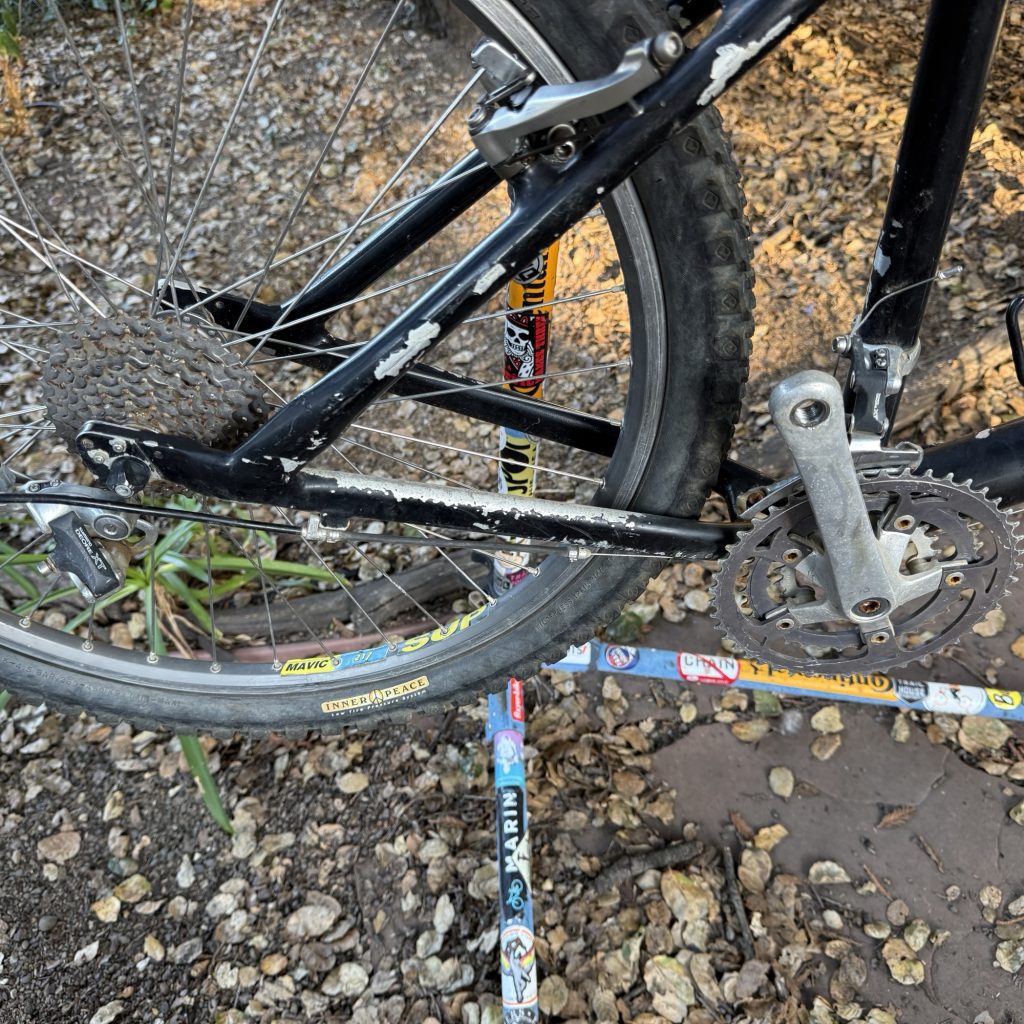
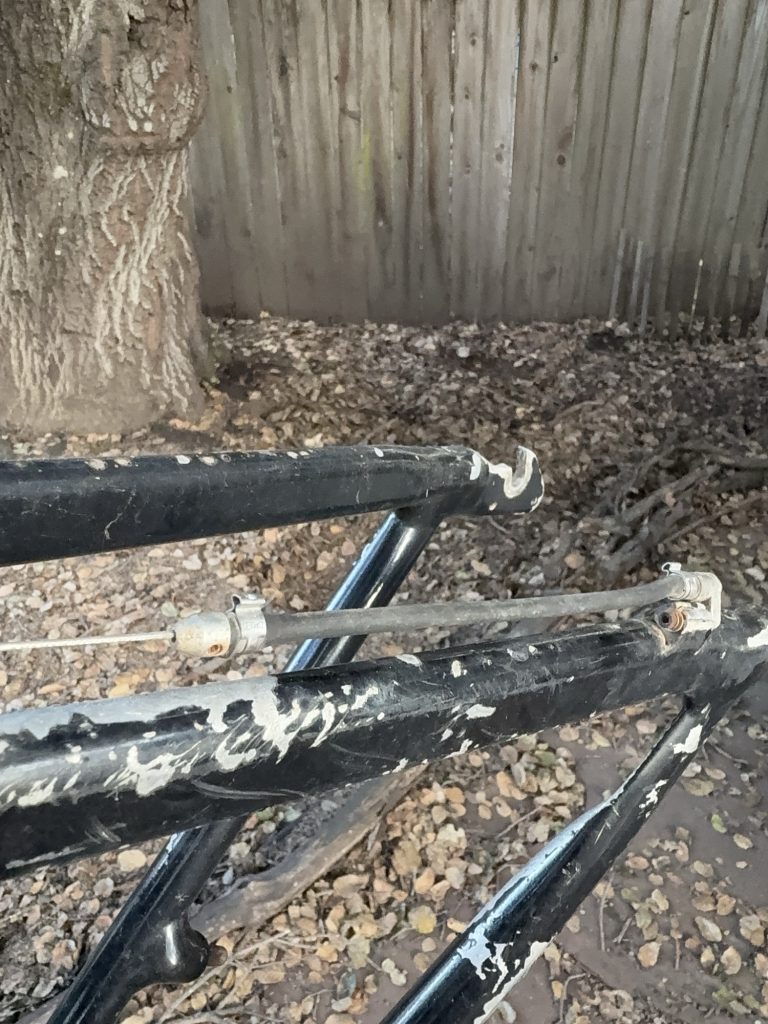
This looks like a special way to keep the gunk out of a derailleur cable. The rubber tube has a metal connector at one end that holds the cable with a grub screw. There is a strange swinging stop that attaches to the frame stop, and looks like they work together in such a way that I couldn’t steal the swinging stop for another bike.
A friend returned a bike I put together for them, and included an old Cannondale! Yay! But… 1.25” headtube, blown Judy fork, bent derailleur.
Kind of made me mad, since I’d just got a new bike (the Fitz), and sold a bike (the Swobo), and I was looking to downsize not metastasize. Which is why there isn’t any kind of documentation to this weirdo bike.
It was also a bad sign that my friend “CannonDave” who will drive four hours to buy a $50 Cannondale frame wouldn’t take the whole bike off my hands for free.
Sam, a reader and iBOB writes:
Hi Philip
I saw your post about the weird vintage detail on the Cannondale frame you received. I totally see how it would also keep gunk out, but the set screw that clamps the cable is a clue to its true purpose. That is a Gripshift Bassworm. It came out in the mid 90s as a shifting “upgrade”. As Gripshift gained market share and replaced Shimano rapid fire shifters both in the oem and aftermarket, Shimano lightened its return springs in the rear derailleur. The Gripshift have a coil of cable in the shifter adding just enough friction to make their performance quite poor with the light action return springs while leaving rapid fire shifters unaffected. Coincidence or aggressive competition tactics by Shimano? We’ll probably never know. But Gripshift put these out to increase the return springs pull and make up for the extra friction in a Gripshifter. The rubber tube is the “spring” and you were supposed to install it with a bit of stretch while in the smallest cog. As you shifted through the rear cassette, the rubber tube would stretch and then when you shifted through back down to the small cog it would yank that cable back through the housing, effectively increasing the return spring. Gripshift didn’t want to advertise that there was a problem with its shifters and Shimano derailleurs, so it marketed these as an upgrade for everyone (and it worked the same on any bike so it was universal I guess), but it truly was a way to bridge a cunningly engineered compatibility gap. Soon after Gripshift became SRAM and started making its own ESP derailleurs and the rest is history. Anyway, thanks for ringing a bell in this old mechanic’s memory, and sorry to bend your ear with an unsolicited tale of bike industry intrigue from the mid 90s. I do enjoy your blog, so chapeau bas!
Thanks,
Sam in Brooklyn (ibob member)
Leave a Reply