

Pencil underlay for a Bicycle Times illustration.
 update: it’s better to search in the /bik section of Craigslist. Craigslist seems pretty consistent there, which is aweseome. That way you can search for “Bridgestone,” without getting tires. site:craigslist.org/bik bridgestone
I use Google’s site search a lot. It’s especially good for big, distributed sites like Craigslist. You can search across all Craigslists in all cities for whatever you think you might pay to have shipped.
Killer old mountain bikes, maybe.
So: looking for a $150 Bontrager Privateer (they were an amazing bargain at 10x the price 10 years ago)? site:craigslist.org bontrager privateer
site:craigslist.org bridgestone mb
Copy and paste the link, because WordPress hates linking to a string like that. It just won’t.
Stupid stupid blog creature!

Last Friday, Bike Snob linked to one of my pictures as an answer the a Friday quiz question. The results were pretty spectacular. 2700 views in 12 hours.
It looks like the Monday Wave of people reading Bikesnob at work overlapped with the rush of bike nerds looking at my pictures from the Oregon Handmade bike show… on Monday, at work.


I had a fantastic long weekend of bike fun, starting with Thursday’s Builders’ Bike Ride, courtesy of the Oregon Handmade Bicycle Show and the editors of Dirt Rag and Bicycle Times (thanks Karen!).
The ride wended around Portland, starting at UBI and ending up at Strawberry Cyclesports, which is also Andy Newlands’ home. The builders on the ride included Tony Pereira, Wade (Vulture) up from Bend, and Andy Newlands himself.
The first stop was the shop that Joseph Ahearne (Ahearne Cycles, duh) and Mitch Pryor (MAP Cycles) share.
 We looked at Ahearne’s cycletrucks, which are made by Co-Motion to his design, and Mitch’s loverly custom randonneur with the top-end racks. Zow. We worked our way from the front of the shop where the tomato-red show bike was being built up, through the work area, the cycletruck storage and other-bike storage to the very back of the space, where they used to have an archery butt.
  Opening all the intervening doors turns the shop into a 30-yard indoor practice range. I was telling my nine-year old son about it, and he thought it was cool until I mentioned they used to find stuffed animals and use them as targets. Oops. His eyes narrowed. “Those guys are jerks!” He believes toys have feelings, and stuffed animals are only slightly less noble than cats. Sorry.
After the Ahearne/MAP shop, we had some stressful round-abouts because the itenerary had been changed at the last minute to send us out to see Tsunehiro, instead of Metrofiets. We went by the back wall of the new Vanilla shop, but didn’t stop in. I ended up losing a pedal platform sprinting across a sketchy street while a firetruck stopped traffic for us. (Did I tell you I got BikeSnobbed on Friday?)
We arrived at a big building that houses a large screenprinting operation (it’s where all the amusing and offensive bumper stickers in the world come from), a traffic-cone factory (wtf?) and Tsunehiro Cycles, Ruckus Components (more on him later), Portland Design Works, and a new messenger-bag and soft-goods company called Blaq.
 A lot of the builder chatter was about milling machines as everyone admired Robert’s new horizontal mill. The non-builders ate donuts, drank beer, and tried not to touch the pair of very pretty show bikes. I had an epiphany: I’m a bike geek, and some of you may be bike geeks, but the people who build bikes… are milling machine geeks. Makes sense. Art connoisseurs talk about composition and color, while artists talk about paints and brushes.
As the tops were popped off some 22 oz brews, suddenly new faces appeared at the door, apparently drawn by the beer sound. “Like cats to a can opener,” someone said. They were the 3 guys from Blaq, and Shawn of Ruckus Components. The highlight of the whole ride was probably Shawn (Ruckus) making vast inroads into converting Tony and Wade to the potential of carbon. Wade said later, “Man, Tony and I went in going, ‘steel is real,’ and we left going, ‘whoa.’”
We finished up at Andy Newlands’ Strawberry Cycles shop-and-home for some amazing homemade salsa, beer, bread, and cheese.  We saw more machinery (Andy is the North American distributor for Marchetti frame building tools), and some Argonaut frames that Andy’s shopmate builds. Argonaut had some of the tightest bikes I saw at last year’s show, and I was sorry not to see his work at the 2010 show.
 We also got to see a beautiful and intricate wishbone stay lug. Maybe it has a special name, but it’s an elegant little number, and I’d be proud to have one on my bike.
After a really nice social around the chip bowl, sampling Andy’s arsenal of Ninkasi beers, I said I had to get away to meet a friend to see a concert at the Crystal Ballroom. The ride leader Evan Ross (Portland Bicycle Tours) gathered us all up to head down to the ArtCrank poster show. I really did have to jet, so all I could do was glance in at the ArtCrank bicycle poster show. Ah irony, thy taste is metallic.
Evan loaned me his own bike map in case I got lost, and I was pleased to return it at the show on Saturday. The City prints them! So cool. They fold up to about the size of a credit card, and show the streets and public transit infrastructure. I highly recommend his company as a tour leader, and he says he does a lot of tours for city planners from other places, showing off the Portland infrastructure.
Friday was a Builders’ Social, a party at the exhibit space with free beer and unsupervised poking of show bikes.
 I got to talk to Shawn of Ruckus for a while one-on-one, which was instructive. He’s a young man from Wisconsin with a degree in composites engineering. He believes the bike industry should be leading the aerospace industry instead of “copying stuff that’s like 20 years old.” His business repairs failed carbon bike parts, and he says carbon is infinitely repairable. “You can make a roadside repair with fabric and epoxy, and make it home, or someplace safe.” According to him, carbon is completely misunderstood by the bicycle industry. He wasn’t talking about retrogrouches who hate it, he was talking about the people who design bicycles with it! “If you make anything as light as it can be, it’s going to fail.’
He wants to make a carbon fiber Pugsley one day.”Oh man, snow biking is so fun!”
Saturday was the show, where I took a lot of pictures.

I discovered a few things going on the Builders’ Ride. The first one is that I’m a bike nerd, and I know some bike nerds, but the builders who make the bikes that bike nerds swoon over… are milling machine nerds!

Friday on BikeSnobNYC, my pedal platforms were a featured answer to the Friday Fun Quiz. Thousands of hits. If you came from there, welcome! 
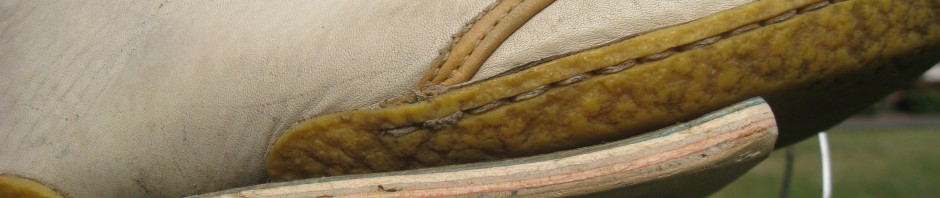


You can buy these from me for $25/per pair, shipped, withOUT cleats. They’re drilled for Eggbeaters, which works for SPDs as well. Email me your request at philip@biketinker.com
These are the biggest. For riding 10 minutes to work, I thought they were silly, but for hauling four hours over 35 miles of gravel, they worked great. The shoes are extremely flexible Borns, very soft and comfortable. I huffed and I puffed, but my feet held up great.
They are marked R and L, but the R is on the left, and the L is on the right. What looks best isn’t always what feels best. These don’t seem that big in comparison to my size 12 feet, either. Maybe I should make an even larger pair , and call them the “molto extremo.” Maybe use an entire skateboard for each pedal.
The whole point of these pedal platforms is so you can ride to the store on the same pedals you race cross in, but it’s gotten so I just like riding on such a big grippy surface that I’ve gone a little nuts.


A watercolor over graphite painting of my 1988 Phil Wood bottom bracket, along with its original receipt from Mill Valley Cyclery. This ran in Dirt Rag magazine to promote its 20 year anniversary in 2008.

skeleto skate deck pedal in the rain, originally uploaded by Philip Williamson.
Excellent grip in the wet; we didn’t encounter the right kind of friction-free mud to see if the holes helped with that. They certainly don’t hurt, and they look cool.
These are prototypes made from (what appeared to be) unusable pieces of skateboard. Please forgive the unfinished hole-edges.
This weekend, I took a pretty rough pair of blanks and started messing around to see what I could do with them. This is a stopgap post to show what happens when I get distracted, and to work out a few ideas on the skate deck pedal design. Same thing, really.


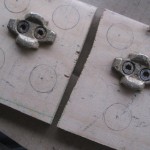


I drilled some 3/4 and 1″ holes to skeletonize the pedal tops and allow mudshedding. Street shoes and slippy Oregon mud make a pretty slippery combo on these pedals. I’ve experienced it twice in about five years, but I’d like a simple fix. I figure holes might work, or BMX pins.
I also added angled screws as toe-flips to give the soles of my shoes some purchase in dragging them upright. I usually dig my foot underneath, and flip them over from the rear, which is the exact opposite of normal toe-clip behavior. Experienced cyclists who borrow my bikes seem have a freakishly hard time getting “into” the pedals. I’d like to devise a method that works with, rather than against, the learned behavior. New cyclists and people who grew up with clipless pedals may not have this problem.
And I experimented in putting the cleat toward the front, instead of centered, in order to make the pedal hang more vertically, instead of upside-down. This should make it easier to kick the pedal flat, instead of having to hook it from the bottom.
The offset cleat is nice. I can feel my toes hang over a bit, but it doesn’t bother me. Running them backwards (long in the front, short in the back) sucked, which was expected. I will make some extra-long inserts, since I like the extension under my foot, but could use some toe-support. For reference, my feet are size 12 (46.5 euro?).
Eh. Works with the Borns, not the workboots. Really, the stiffer grease in the Candies vs the regular Eggbeaters makes it easier to get onto the pedal without flipping. The pedal doesn’t ‘swing’ as much, so it comes up flat at the top of the stroke.
I like them. They may be a permanent feature. You can’t tell feel them, and they probably make the pedal a little lighter. I haven’t tested them in mud yet, but I don’t have high hopes there. Mud is mud.
I like the way the four hole version looks, but not the three holes. The three-hole version looks like a screaming monkey face, and who needs that?

Like the Truvativ HammerSchmidt, and predating it by about 10 years, is a Swiss bottom-bracket two-speed planetary gear changer. It comes in several types (1:1.65; 2.5:1; 1:2.5).
Yep. Ever since late 2009, according to their website. The older ones no, the newest ones, yes. The internals are symmetrical, so they engage as well forward as backwards.
You can use a Schlumpf for a two-speed fixed setup, or mate it to a 3-speed fixed gear hub for six fixed gears.
The SpeedDrive has the same 1:1.65 gear ratio as the HammerSchmidt, so the same nice spread can be had on a road-going fixed-gear. There are lots of chainrings available (9, vs 2 for the SRAM HammerSchmidt): 27, 28, 30, 32, 34, 36, 38, 40 or 42. The rings are bigger, so your cogs are going to be bigger to get the same gears. That’s a bonus, since bigger drivetrain parts last longer.
A 34t ring and a 21t cog would give you a 44″ low and a 73″ high gear. I like that.
 If you’d like to play with the numbers, Sheldon Brown’s gear calculator has a dropdown for the Schlumpf. Of course it does!
Nope. Just like for the HammerSchmidt you’ll have to modify your frame. The Schlumpf needs to have a 45° angle beveled into your bottom bracket to set against. Schlumpf says they can rent you a mitering machine “in most countries.” The bevel doesn’t keep you from reinstalling a normal bottom bracket on your frame, so it’s non-destructive.
All the best high-performance, sturdy internal gear and niche-market hubs have intense chunky German names: Rohloff, Schmidt, Fichtel und Sachs, Schlumpf. I’m sure that’s why SRAM made up “HammerSchmidt.” It sounds bad ass.
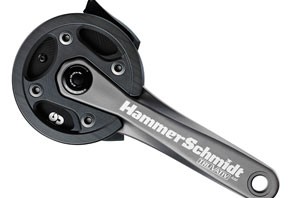
Nope. The cranks themselves freewheel, so the bike would no longer be fixed. If you put Hammerschmidt cranks on a fixed-gear, it will turn it into a freewheeling-enabled double-singlespeed bike. 
But, yep. Nothing would be damaged, it just wouldn’t be a fixed wheel. And… you could run a superlight singlespeed rear wheel. A Shimano or White freewheel weighs a lot more than a 15t (or 12t Phil!) fixed cog.
Sure. With a little help from a framebuilder. You’d need the proper “ISCG 03 or ISCG 05 tabs” (whatever those are) retrofit to the bottom bracket.
The HammerSchmidt only has two chainring sizes available: 22t and 24t, which forces you to choose a very small cog if you want to use it on the road.
I had thought the spread was too big, until I did the number-crunching. I like a wide range, because of where I like to ride. A normal gear for most times, and a low low for climbing.
I calculated the low gears with Sheldon’s gear calculator, then multiplied by 1.65 to get the high gears.

I could have (should have) just chosen Schlumpf Speed Drive Bottom Bracket from the “internal gear hub” dropdown, since the multiplier is also 1.65. The numbers aren’t the same, but they’re close.
These gears and opinions are theoretical in nature – follow your own folly.
I would really like to hear about (and see) any road bikes set up with HammerSchmidt crankset. And if Truvativ wants me to test one, I think I can add the tabs…


My type of Aucklander…, originally uploaded by ibikenz.
ibikenz’s bike graphics are really cool. I’d wear the T-shirt. Check out the ‘Bicycle Friendly North Shore’ blog – it’s Spring down in New Zealand!
I was in Auckland, NZ for three hours once, in 1988, on a layover from Australia. Two weird things happened in Auckland – I was paged on the PA, but it turned out to be a DIFFERENT “Philip Williamson” (50ish, British) who was wanted.
And my bike stayed there. It was supposed to go to OAKland, but they took it off in AUKland.

 That was surprising.

