Category: Resources

Helpful files and links to online resources

  • “Cobra” tire tool

    “Cobra” tire tool

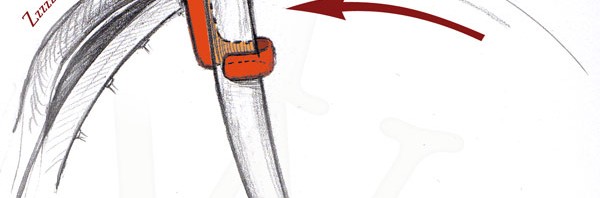
    I just saw this new tire tool on Google+. You hook the little bit under the bead of the tire, hook the big hook over your fork or chainstay and turn the wheel backwards. I usually pop my Pedro’s tool under the bead and shear it off the rim like carving bark off a stick. Same principal, I guess.

    pw drawing of cobra tire tool

    It looks good, and I’m in favor of anyone devising new tools, but I usually have trouble MOUNTING tires. That’s where all my tire levers go – into two pieces putting the current tires on Angelina’s old Steyr. When there’s a Cobra tool that can zip the bead back on, I’m buying one. $5.99 each, free shipping for two. Let me know how they work out for you.


  • Inexpensive Alfine dynamo hubs

    Inexpensive Alfine dynamo hubs

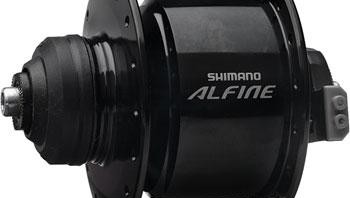
    The OTHER killer deal on something I needed (that won’t make me throw up in my mouth a little*) was a $51 32 hole Alfine dynamo hub in black, exactly like the $120 one I’ve been saving up for. Total came to $63 with shipping to Oregon. If you live in Colorado, it’s cheaper.

    the picture doesn't show the packaging anyway...

    I saw an “OE Pack” hub on eBay for a great price, and then Googled it. After poking around a few sites that also carry the item, it turns out ebikestop.com has the same Alfine hub, at the best price. Since they have pretty helpful customer service, I emailed them to make sure it wasn’t just like the replacement internals or something, and yup, it’s the exact same hub as the more expensive Alfine hub they carry, but without the fancy packaging. Since I plan to build the hub into a wheel, rather than save it in acid-free plastic, I’m pretty pleased at the deal.

    I imagine this either means that Shimano is coming out with something much nicer for 2012, or the brief OEM flirtation with dynamo hubs on city bikes is officially over.  As someone who’s riding E6s instead of LED headlights and buys used CDs instead of downloading MP3s**, that’s fine with me.

    *to borrow a quote from Bike Snob commenters circa 2008.
    ** 10 mp3s for $3? In an archival re-rippable format? Okay.

  • Relative sizes of smaller Carradice Bags

    Relative sizes of smaller Carradice Bags

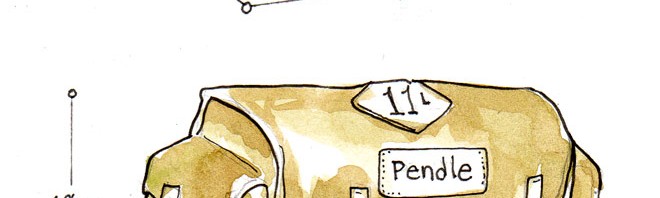
    I was having the darnedest time figuring out which of the smaller Carradice bags I wanted. On the internet, they all look relatively the same size,  because the sellers maximize the size of the picture, and the Barley looks exactly like the Nelson. I have the Cadet, and would like something the same size, but with side pockets for keys and camera.

    So I painted this little cheat sheet. As soon as I was done, I started looking at other bags, though.

    watercolor reference for small carradice bagsAnd… I think the lowsaddle longflap is the step up from the Cadet. It’s (of course) not illustrated here, but it’s 15 liters, which SEEMS like it would be a Cadet with side pockets, which is exactly what I want, in green, for the front of the Quickbeam. I want the pockets for cameras and/or toolkits. I’m also considering a zipped roll to hang under the left side of my basket to hold a toolkit.

    I like the bar-mounted saddlebag and basket combo. A camera or dozen eggs is isolated from the direct shocks from the frame, and when you put, say, a 12 pack in the basket, the bag simply rotates up to sit on top of the box. The only downside is that it’s more difficult to ride on the tops near the stem, which I never do anyway.


  • Even fatter tire equivalencies!

    Except… the fatbike/snowbike tire has a larger OD than anything else you can buy! Is this true?

    559 (26″ mtb) 584 (650B/27.5″) 622 (700C)
    92mm 76mm 56mm
    92mm 76mm 56mm
    743mm OD 736mm OD 734mm OD
    3.8″ Fatbike 3″ 27-five 2.55″ 29er

    Dialing back the fatbike tire, so we have some equivalencies. The 650B still drops out of this race.

    559 (26″ mtb) 584 (650B/27.5″) 622 (700C)
    87mm 74mm 56mm
    87mm 74mm 56mm
    733mm OD 732mm OD 734mm OD
    3.45″ Snow 2.8″ DH 650B
    2.55″ 29er

    This might be taken as an argument for 24″ fatbike tires… a real fat snow tire in 24″ (iso 507) would be 507+90+90=687, or the same Outer Diameter as a 32mm road tire and a 2.5″ mtb tire.

  • Wheel diameter with different tires

    Now that I have a bike project underway involving disc brakes and decent clearances, I sat down and did with a purpose something I’d done a couple times just for fun: figured out tires for 700c, 650B and 26″ rims that give equivalent wheel diameters*.

    Now it’s inscribed in the immutable internet, and I can refer back to it later.

    Narrower. In my circles, the 42mm 650B “Hetre” is the most-hyped tire… well, ever. I’ve never ridden it. Of these first three, the 2.1″ mtb tire is the only one I’ve ridden, and I’ve worn them bald. It’s a good size. I’ve also ridden a 590×37, which has a similar OD to the 650B, (and can be boughten or ordered at any LBS). It was also a good size, for the bike it was on.

    559 (26″ mtb) 584 (650B/27.5″) 622 (700C)
    53mm 42mm 23mm
    53mm 42mm 23mm
    665mm OD 668mm OD 668mm OD
    2.1″ MTB 42mm 650B 23mm 700C

    Plumper. I’ve only ridden the 32mm tire. Good for everything but deep gravel, which is just sucky no matter what.

    559 (26″ mtb) 584 (650B/27.5″) 622 (700C)
    63mm 50mm 32mm
    63mm 50mm 32mm
    685mm OD 684mm OD 686mm OD
    2.5″ MTB 2″ 27-five 32mm 700C

    I do not know of anyone who’s actually set up a bike with interchangeable wheelsets in different sizes, but it must’ve been done. It’s probably common in some circles.

    * The rolling diameter is important-ish, because a big mismatch can affect the handling, standover, pedal clearance, etc. I’ve happily and comfortably run 25s through 40s on my Quickbeam, but that’s the best bike in the world and can do anything.

  • Tire pressure calculator google doc

    I made a page / menu item page for Dave Adams’ tire pressure calculator. It’s up there next to “Home.” I just got tired of digging for it.

    Visit the Pressure Page.

    It’s a Google Doc now, which should be easier than downloading an Excel spreadsheet. The XLS file is still available on the original pressure post.

    Loz made a French open document version (weight in kilos and pressure in bars) : http://l0z.free.fr/velo/pression-pneu-ideale-ISO.ods

  • dork nut adapter for schrader rims

    dork nut adapter for schrader rims

    Am I the only one that calls these dork nuts?

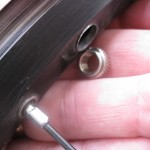
    dork nutI was very pleased to find this presta valve-stem nut in my parts bin. No idea where it came from, but I’m certain I didn’t spend $2 on it*. The first time I tried to find this thing online, I found $5 prices, which was a funnier link.

    I might actually pay $2 for this, since it lets me put a presta tube securely into a schrader-drilled rim. My SON wheel is drilled for schrader valves, because the builder and former owner is an avowed enemy of presta valves. Wade, of Vulture Cycles, points out that schrader valves are found everywhere in industrial applications, and presta valves are only ever found on bicycles. Where they suck.

    They do suck, too, which is why dork nuts even exist. I used to leave them off my valve stems to save weight and rattliness. I started using them when I had several tubes fail at the stem, especially on my mountainbike.

    Fat guy, fat tubes, low pressure, and the tube starts to creep inside the tire. The stem starts angling over, and stresses out the base where it attaches to the tube. Pretty soon it’s an irreparable leak.

    All that said, I still wanted to put a presta valve into this schrader-drilled rim. It’s easier than drilling out 9 or 10 rims and buying all new tubes. Or even pulling the stuck-in tubes out of the IRC Mythos and WTB whateveritis and switching them. The one I pulled off the Sachs Automatic already had a tube happily mated in, and tire-swaps are a lot easier if the tube is stuck in the tire.

    So I was pleased to see that this unusual dork nut was specifically made to fit exactly into  a schrader valve hole and hold a presta valve securely.

    Here’s what Jobst Brandt has to say about schrader vs presta valves (sheldonbrown.com).

    And that’s my ‘longest post on smallest subject’ blog contender!

    * I bought the S3X from eBikeStop.com. Good service and the best price I found. I had a pleasant email exchange with Justin (store manager) about hub and shifter options. Recommended.

  • funky bottom bracket removal

    My bossfriend came over last night to borrow a bike tool I didn’t have.

    His Schwinn hybrid has a bottom bracket (the spindle your cranks attach to) with a weird raised center portion about the same shape as a Vienna Finger. He could get a big Crescent wrench on there, but it kept slipping off every 1/4 turn.

    After about 20 minutes of rooting through my tooldrifts, I remembered a Sheldon trick for removing singlespeed freewheels – put the tool on the freewheel, then the nut on the axle, keeping the freewheel tool from popping off under torque.

    Ah… what if you put the crank back on the spindle, to keep the wrench in place? Worked genius.

    I should’ve gotten a picture of the bearings when he got them out! The cage (cage?) was flattened, ripped, and wrapped around the spindle. Nasty.

  • Honjo Mudguards Fender Catalog

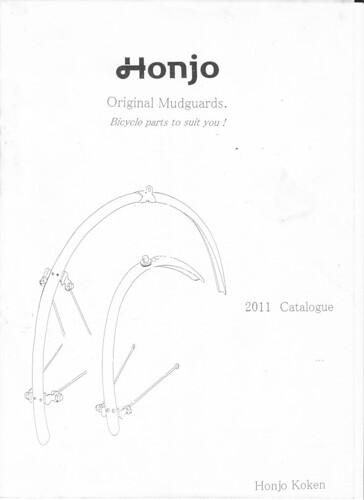
    Honjo Mudguards Fender Catalog, originally uploaded by boxdogbikes.

    I can’t believe so few people have been looking at this. Very high on the coolness meter, courtesy of Box Dog Bikes. Go look at it. My metal fenders are all Velo-Orange, but Honjo is legit.

    Two polished fluted fender choices from Honjo-Koken's 2011 catalogI like the H47, a pretty, fluted 48mm fender. And the H79m, its burlier brother.


  • Multi-speed Fixed Quickbeam

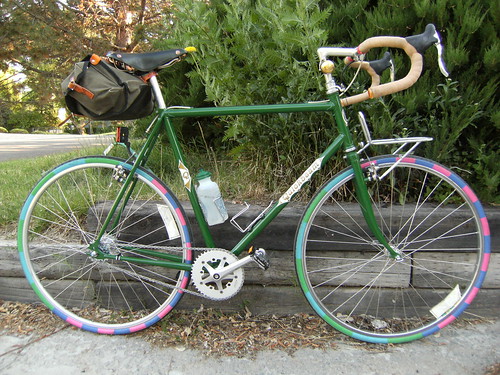
    Quickbeam, originally uploaded by gjtramey.

    From one of my Flickr and RBW group friends. I like his gear spread for a go-anywhere fixed gear bike. He’s using the Surly Dingle double-fixed cog and some larger rings than the stock Rivendell setup.

    Rings: 39/45
    Cog 1: 17/21 Surly Dingle cog
    Cog 2: 23
    Gears: 46, 50, 58, 62, 71.5

    I’ve migrated toward larger rings on road cranks, too, but I like his 23t flip cog better than a 15t cog. That’s a beautiful spread. He can drop from 72″ to 50″ without taking the wheel out of the dropouts. Flipping the wheel, his biggest and smallest gears have the exact same axle position.

    39
    rings 45
    17
    61.9″
    71.5″
    cogs
    21
    50.1″ 57.9″
    23
    45.8″ 52.8″

    Running the numbers, we can see that he must be using 32mm tires. And, uh, plus we can see them. 38 or 40mm tires will give slightly taller gears.

  • Find bikes on Craigslist

    update: it’s better to search in the /bik section of Craigslist. Craigslist seems pretty consistent there, which is aweseome. That way you can search for “Bridgestone,” without getting tires. site:craigslist.org/bik bridgestone

    I use Google’s site search a lot. It’s especially good for big, distributed sites like Craigslist. You can search across all Craigslists in all cities for whatever you think you might pay to have shipped.

    Killer old mountain bikes, maybe.

    The syntax is “site:craigslist.org” “search terms”

    So: looking for a $150 Bontrager Privateer (they were an amazing bargain at 10x the price 10 years ago)? site:craigslist.org bontrager privateer

    A Bridgestone MB-something?

    site:craigslist.org bridgestone mb

    Copy and paste the link, because WordPress hates linking to a string like that. It just won’t.

    Stupid stupid blog creature!

  • Schlumpf double-fixed

    Schlumpf double-fixed

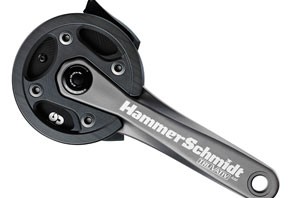
    Like the Truvativ HammerSchmidt, and predating it by about 10 years, is a Swiss bottom-bracket two-speed planetary gear changer. It comes in several types (1:1.65; 2.5:1; 1:2.5).

    Can I use the Schlumpf with a fixed gear?

    Yep. Ever since late 2009, according to their website. The older ones no, the newest ones, yes. The internals are symmetrical, so they engage as well forward as backwards.

    You can use a Schlumpf for a two-speed fixed setup, or mate it to a 3-speed fixed gear hub for six fixed gears.

    The SpeedDrive has the same 1:1.65 gear ratio as the HammerSchmidt, so the same nice spread can be had on a road-going fixed-gear. There are lots of chainrings available (9, vs 2 for the SRAM HammerSchmidt): 27, 28, 30, 32, 34, 36, 38, 40 or 42. The rings are bigger, so your cogs are going to be bigger to get the same gears. That’s a bonus, since bigger drivetrain parts last longer.

    A 34t ring and a 21t cog would give you a 44″ low and a 73″ high gear. I like that.

    If you’d like to play with the numbers, Sheldon Brown’s gear calculator has a dropdown for the Schlumpf. Of course it does!

    Can I slap this on my bike and go?

    Nope. Just like for the HammerSchmidt you’ll have to modify your frame. The Schlumpf needs to have a 45° angle beveled into your bottom bracket to set against. Schlumpf says they can rent you a mitering machine “in most countries.” The bevel doesn’t keep you from reinstalling a normal bottom bracket on your frame, so it’s non-destructive.

    What’s with the crazy names?

    All the best high-performance, sturdy internal gear and niche-market hubs have intense chunky German names: Rohloff, Schmidt, Fichtel und Sachs, Schlumpf. I’m sure that’s why SRAM made up “HammerSchmidt.” It sounds bad ass.

  • HammerSchmidt double-singlespeed gearing

    HammerSchmidt double-singlespeed gearing

    Does the HammerSchmidt crankset work with a fixed wheel?

    Nope. The cranks themselves freewheel, so the bike would no longer be fixed. If you put Hammerschmidt cranks on a fixed-gear, it will turn it into a freewheeling-enabled double-singlespeed bike.

    But, yep. Nothing would be damaged, it just wouldn’t be a fixed wheel. And… you could run a superlight singlespeed rear wheel. A Shimano or White freewheel weighs a lot more than a 15t (or 12t Phil!) fixed cog.

    Can I use this thing on a road bike?

    Sure. With a little help from a framebuilder. You’d need the proper “ISCG 03 or ISCG 05 tabs” (whatever those are) retrofit to the bottom bracket.

    The HammerSchmidt only has two chainring sizes available: 22t and 24t, which forces you to choose a very small cog if you want to use it on the road.

    Road Gearing

    I had thought the spread was too big, until I did the number-crunching. I like a wide range, because of where I like to ride. A normal gear for most times, and a low low for climbing.

    • 24/15 = 44″ and 70″ gears – I’d run this setup any day.
    • 24/14 = 47″ and 75″ gears – If it was a fixed drivetrain, it would be ideal.
    • 24/12 = 54″ and 87″ gears (for time trialing over mountain passes?)

    Offroad XC (non-Downhill riding)

    • 22/15 = 40″ and 64″
    • 24/16 = 41″ and 65″

    I calculated the low gears with Sheldon’s gear calculator, then multiplied by 1.65 to get the high gears.

    I could have (should have) just chosen Schlumpf Speed Drive Bottom Bracket from the “internal gear hub” dropdown, since the multiplier is also 1.65. The numbers aren’t the same, but they’re close.

    These gears and opinions are theoretical in nature – follow your own folly.
    I would really like to hear about (and see) any road bikes set up with HammerSchmidt crankset. And if Truvativ wants me to test one, I think I can add the tabs…

  • Optimal Tire Pressure for bicycles

    Optimal Tire Pressure for bicycles

    EDIT 2022:

    Just use Jan’s calculator:

    Run it for your bikes and write the pressure on the tires or the rims.


    Ignore all this old stuff:
    Here’s a short overview of tire pressure on the Problem Solver’s blog. It’s a little more concise than this page, and has more pictures.

    The Calculator

    The pressure calculator was created by Dave Adams, who sent it to me because of a tire pressure post I’d put up with an extended chart. You can open the spreadsheet in Open Office, Excel, or Google Docs and use it for free. Just remember “Dave Adams” when you use it.

    How to Use It

    Fill in the yellow fields in the spreadsheet (tire width; bike and rider weight; percent of weight on each tire). Go pump your tires. You can make (copy) a tab for each of your bikes, and make the tires and rider fatter or thinner over time (or adjust for touring loads).

    The Science

    According to Frank Berto and Jan Heine (of Bicycle Quarterly magazine), two top bicycle science guys, the most efficient bicycle tire pressure is one that gives you a 15% drop in tire height when you get on the bike. “This tire has too little air!” It’s squishy and hard to turn. “This tire has too MUCH air!” It loses energy bouncing off small surface irregularities. “This tire is JUST RIGHT!” Fifteen percent is the Mama Bear of tire drop.

    Given that you want each tire to ‘drop’ 15%, and bikes don’t weight the front as much as the rear, you don’ t want the same amount of air in each tire. It seems obvious when you think about it, but it was  revelation to me.

    Most bikes put 60% of the weight on the rear, for a 40-60 fore-aft weight distribution. The “Quickbeam” tab in the spreadsheet is set up this way, and I actually weighed the bike with me on it to get the split. I could have saved some work and trusted to Bicycle Quarterly, but I like to check things for myself.

    Low-trail French Randonneuring bikes are different, with only 55% on the rear. The “Ross” tab in the spreadsheet is for my low-trail Ross Super Grand Tour fixed gear tourer. Also weighed out accurately to confirm the BQ numbers.

    Dave says his equation looks like this:
    PSI = 153.6 * Weight / (TireSize^1.5785) – 7.1685

    History

    A few years ago, in the Spring of 2007, Bicycle Quarterly had a “Tire Drop” article based on Frank Berto’s research about proper inflation for best efficiency, in which they published a very useful graph, and instructions on how to set up your tires.

    It didn’t have a line for 35mm tires, which I used at the time, so I added another line, and extended it to allow for heavy loads. Jan Heine gave me permission to republish the Bicycle Quarterly graph with my additions, and it turned out to be pretty useful for some people. I actually had an internet friend send it to me, not knowing I’d posted it in the first place.

    graph showing optimal inflation for bike tiresDave Adams saw the post in his research on the same subject, and sent me a copy of his spreadsheet, which I’ve been using ever since. With his permission, I posted it to the  RBW (Rivendell Bicycle Works) Google Group, where it’s also archived.
  • Gear ratios for Torpedo 2-speed hubs

    Figuring your gears is a little tricky with a two-speed hub that shifts by itself. The low gear is 1:1, the high gear is 1:1.36.

    The low gear is direct-drive. There’s no fussing; the gear you calculate on Sheldon’s gear calculator is the actual low gear. It is the 1:1 gear.

    The high gear is 36% larger. I plugged in larger cog sizes until I got ones about exactly 36% larger. I just noticed that Sheldon’s calculator will let you add fractional cogs!

    I’m a double idiot – I just noticed that Sheldon’s gear calculator lets you choose a “Sachs Duomatic / Automatic” hub in the Internal Gears dropdown. This way is a little easier to read, though.

    I have a 19t sprocket, and a 22t sprocket. I also have 39, 40 and 42 tooth chainrings I think might work for this project.

    The “high gear equivalent” for the 19t is 13.97 (let’s call it a 14). The “high gear equivalent” for the 22t sprocket is 16.18. Again, 16 is plenty close.

    With a 19t cog and a 39t chainring, I get a low gear of 56″ and a high of 76″

    39
    40
    42
    19t low
    56.1 57.5 60.4
    36.0 %
    high 76.3 78.2 82.1

    With a 22t cog and a 42t ring, I get my ideal setup:  52″ low and 71″ high gear.

    39 2.6 % 40 5.0 % 42
    22t low 48.4 49.7 52.2
    36.0 %
    high 65.9 67.5 70.9

    The Sachs Torpedo 2-speed gives a slightly wider ratio than my double fixed setups that use a 17/21 Surly dingle cog and a four-tooth chainring difference.

  • Grant Petersen shows how to draw a bicycle frame.

    Grant Petersen shows how to draw a bicycle frame.

    This is pretty cool. In the “Peeking through the Knothole” section of Rivendell Bicycle’s site, Grant is going to walk people… the world, I guess, through how to draw a bicycle frame, one baby step at a time.Grant Petersen's favorite eraser

    Step 1. Get the drawing tools. 11×17 graph paper, 360° protractor, metric ruler, metric triangle, pencil… and an eraser.

    I think in an old Reader, he did a similar thing, where he showed you how to make a full-size production drawing of a bike frame. Maybe it was the Bridgestone Catalog.